

Imagine this scenario.
A student is checking out your online course preview and decides to make a purchase.
Instead of going through the hassle of lengthy payment forms or entering credit card details, they just scan a QR code or tap “Pay via UPI.” In just a few seconds, the payment is done.
No card numbers involved. No annoying payment gateway delays. No waiting around. It’s that straightforward, thanks to UPI (Unified Payments Interface) a technology that has quietly become the backbone of India’s digital economy.
Nowadays, UPI is at the forefront of India’s digital payment landscape, managing the bulk of retail digital transactions across the country. (UPI)
For educators, creators, and platforms offering online courses, this innovation has transformed everything—from the checkout experience to conversion rates and market reach.
Let’s dive into what UPI is, how it operates, and why it’s revolutionizing online course sales in India.
What Is UPI?
The Unified Payments Interface (UPI) is a cutting-edge payment system created by the National Payments Corporation of India (NPCI). It allows you to transfer money between bank accounts instantly using mobile apps.
(Research Gate)
Forget about debit cards, credit cards, or even sharing your bank details; with UPI, you can make payments using a straightforward virtual payment address (VPA) like:
akash@upi
or simply by scanning a QR code.
UPI brings together various banks into one seamless payment ecosystem, making it easy to:
- Transfer money between people
- Make payments to merchants
- Settle transactions instantly
- Conduct transactions 24/7
Thanks to its user-friendly design and ability to work across different platforms, UPI has quickly become one of the largest real-time payment systems globally, handling billions of transactions each month.(Source)
Some of the popular apps that utilize UPI include:
- Google Pay
- PhonePe
- Paytm
- Amazon Pay
These apps serve as the user-friendly interfaces, while the robust payment infrastructure is managed by NPCI.
How UPI Works (Simple Explanation)
To really grasp how UPI has revolutionized online course sales, it’s essential to appreciate just how seamless the system is.
So, what goes down during a UPI payment?
Step 1: The buyer opts for UPI
When someone is ready to buy an online course, they simply choose UPI as their payment option.
Step 2: Payment request is generated
The platform then sends a payment request straight to the buyer’s UPI app.
Step 3: Authentication
Next, the buyer confirms the payment by entering their UPI PIN.
Step 4: Instant bank transfer
The funds are transferred directly from the buyer’s bank account to the merchant’s account.
And the best part? This whole process takes just 2 to 5 seconds.
Unlike credit cards or digital wallets, there are no middlemen holding onto the money, which makes it not only faster but also more cost-effective.
The Explosive Growth of UPI in India
UPI’s journey has been nothing short of remarkable.
Research and industry reports indicate that UPI has truly transformed the landscape of digital payments in India.
Key statistics:
- UPI handles billions of transactions each month throughout India.(Source)
- It represents about 85% of all retail digital transactions in the country.(TOI)
- India’s digital payments scene now leads the world in transaction volumes.(ORF)
Additionally, research reveals that UPI adoption skyrocketed after COVID-19, with a staggering 70% increase in transaction volumes from 2020 to 2022.(Research Gate)
This impressive growth can be attributed to UPI’s offerings:
- No fees for users
- Instantaneous payments
- Easy access via mobile devices
These elements have made digital payments reachable even in rural and semi-urban areas.(Research Paper)
Why UPI Became So Popular
UPI has tackled several challenges that have long plagued traditional online payments.
1. No Card Details Required
Many users feel uneasy about entering their card numbers online. UPI eliminates this concern.
Instead, users just need to:
- Approve the payment through their app
- Enter a 4 or 6 digit PIN
This boosts trust and enhances the perception of security.
2. Instant Payments
Card payments can sometimes take ages or even fail due to:
- OTP issues
- Bank downtime
- Gateway failures
With UPI, transactions settle instantly between banks. This real-time setup makes the checkout experience smooth and hassle-free.
3. No Transaction Fees for Users
One of the key factors driving UPI’s popularity is its zero-fee model for users.
Since there are no extra charges, people are more inclined to choose UPI over:
- Credit cards
- Debit cards
- Net banking
4. Works With Any Bank
UPI is designed to be interoperable.
That means:
- A user with an SBI account can easily pay someone with an HDFC account.
- Any UPI app can connect with any bank.
This open system has significantly sped up its adoption.(SUERF)
The Rise of India’s Creator Economy
Before we dive into how UPI is shaking up online course sales, let’s take a moment to appreciate the explosive growth of India’s creator economy.
Today, India boasts millions of:
- Educators
- Trainers
- Coaches
- Influencers
Who are busy selling:
- Online courses
- Digital workshops
- Cohort programs
- Paid communities
However, there’s been one significant hurdle all along.
Payments.
In the past, creators relied on:
- Credit cards
- Payment gateways
- Complicated checkout flows
This often led to students abandoning their purchases because of payment hassles. But UPI has completely transformed that scenario.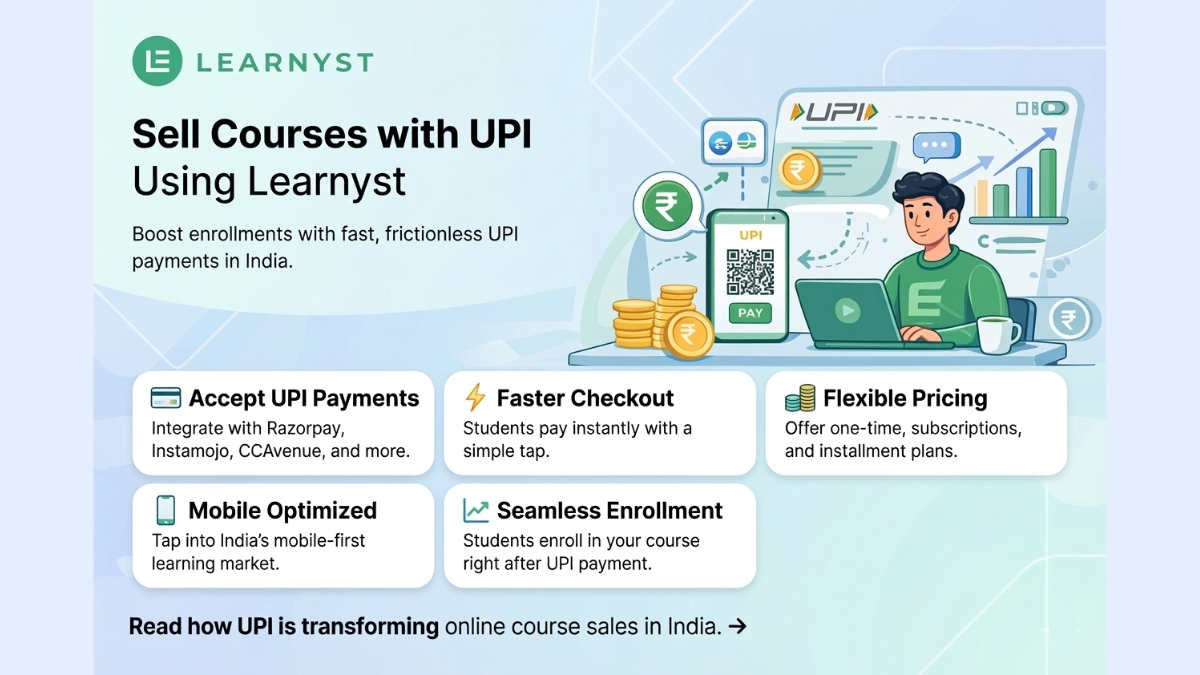
How UPI Is Transforming Online Course Sales
UPI has truly revolutionized the way online courses are sold in India. Let’s dive into the key changes.
1. Faster Checkout = Higher Conversion Rates
One of the main reasons people abandon their online purchases is due to checkout hassles.
A typical card checkout process involves:
- Card number
- Expiry date
- CVV
- OTP authentication
With UPI, it’s as simple as:
Click → Approve → Done
This streamlined process greatly boosts conversion rates for digital products, including online courses.
2. Mobile-First Learning Ecosystem
India is a mobile-first internet market.
Most students purchase courses through:
- Smartphones
- Mobile apps
- Social media links
UPI was designed specifically for mobile payments.
This perfect match between mobile learning and mobile payments makes buying courses a breeze.
3. Access to Tier-2 and Tier-3 Markets
One of the standout benefits of UPI is its role in promoting financial inclusion.
Research indicates that the adoption of UPI has broadened access to digital payments, even reaching rural communities. (Research Gate)
For online educators, this opens up exciting opportunities:
You can now offer courses to students in:
- Small towns
- Rural regions
- Non-metro cities
without the need for credit cards.
4. QR-Code Based Course Sales
Many educators are now leveraging platforms like:
- Instagram
- YouTube
- WhatsApp
- Telegram
Instead of sending out payment links, they simply share a UPI QR code.
Students can scan the code and make payments instantly.
This approach is especially effective for:
- Live workshops
- Webinars
- Short courses
- Mentorship sessions
5. Lower Payment Processing Costs
Traditional payment gateways often impose:
- 2–3% transaction fees
- Additional settlement charges
In contrast, UPI transactions usually come at a much lower cost, allowing course creators to retain more of their earnings.
This is particularly beneficial for:
- Low-ticket courses
- Micro-learning programs
- Subscription content
6. Micro-Payments and Affordable Learning
Thanks to UPI, making small payments has never been easier.
Students can snag courses for just:
- ₹49
- ₹99
- ₹199
This trend is paving the way for more affordable education options in India. For creators, it’s a fantastic opportunity to tap into the mass market with learning products.
7. Subscription and Recurring Learning Models
UPI is also paving the way for innovative business models like:
- Monthly course memberships
- Paid communities
- Coaching subscriptions
As India’s digital payment landscape continues to grow, we can expect UPI to become even more integrated with recurring payment systems.
UPI and the Future of Digital Education
UPI’s influence stretches far beyond just facilitating payments.
It's playing a crucial role in shaping the infrastructure of India’s digital education landscape. The system is also making waves on a global scale.
International fintech companies are jumping on board with UPI to facilitate cross-border transactions and enhance global commerce.(Reuters)
Moreover, cutting-edge technologies like AI-driven commerce systems are starting to explore UPI-based payment options.(Reuters)
This indicates that UPI is set to become an even more formidable asset for digital businesses, including educational platforms.
Challenges and Limitations of UPI
Even with its impressive track record, UPI still encounters some hurdles.
1. Security Concerns
Research Indicates that a number of users are still worried about the risks of fraud and privacy when it comes to digital payments.
2. Transaction Limits
UPI usually imposes daily transaction limits that vary from one bank to another.
3. Platform Dependence
The landscape is largely controlled by a handful of apps, such as Google Pay and PhonePe, which raises some concerns about competition.(Source)
Nonetheless, ongoing improvements in regulations and infrastructure are helping to bolster the system.
Final Thoughts
UPI is so much more than just a payment method; it’s a digital public infrastructure that has completely transformed how money moves in India.
With UPI, payments are:
- Instant
- Simple
- Mobile-friendly
- Accessible to everyone
This groundbreaking innovation has opened up a world of exciting opportunities for the online education sector.
For educators and course creators, this means:
- Easier student onboarding
- Higher payment success rates
- Access to millions of new learners
In a country where digital learning is rapidly gaining traction, UPI is quietly boosting course sales behind the scenes.
As India continues to build the world’s most advanced digital payment ecosystem, the connection between UPI and the future of online education is only going to grow stronger.
FAQs
1. What is UPI and how does it work?
UPI, or Unified Payments Interface, is a cutting-edge digital payment system created by the National Payments Corporation of India (NPCI). It lets users transfer money between bank accounts in real-time using mobile apps. You can make payments with a UPI ID, a QR code, or even just a phone number, and the best part? Transactions are wrapped up in mere seconds
2. Why is UPI so popular in India?
UPI has gained popularity for a good reason: it allows for instant bank transfers, has little to no transaction fees, makes mobile payments a breeze, and works seamlessly across different banks. These features really speed up digital payments, making them super convenient for our daily transactions.
3. Can i accept UPI payments for online course platforms?
Yes, Educators can easily accept UPI payments through the Learnyst platform by integrating with popular payment gateways like Razorpay, Instamojo, or CCAvenue. This setup enables students to buy courses using UPI apps such as Google Pay, PhonePe, or Paytm, granting them instant access to the course right after payment.
Comments