


Artificial Intelligence (AI) has evolved beyond being just a futuristic idea or a trendy term thrown around by tech companies. In fact, you probably engage with AI on a daily basis, whether you're searching for something on Google, scrolling through your social media feeds, getting movie suggestions on Netflix, or chatting with voice assistants like Siri or Alexa.
In this guide, we’ll break down what artificial intelligence truly is, how it operates, the different types of AI, its real-world applications, the benefits and risks involved, and what the future might hold for AI, all in straightforward language.
What Is Artificial Intelligence (AI)?
Artificial Intelligence (AI) is all about giving machines or software the ability to tackle tasks that usually need human smarts, like learning, reasoning, solving problems, understanding language, or even recognizing images.
As noted by Encyclopedia Britannica, AI is described as:
“The ability of a digital computer or computer-controlled robot to perform tasks commonly associated with intelligent beings.”
In simpler terms, AI enables machines to think, learn, and act in an intelligent way, much like we do, just faster and on a larger scale.
How Artificial Intelligence (AI) Works?
To grasp how AI operates, think about how you learn through your own experiences. You observe examples, start to notice patterns, and gradually get better at it.
AI works in a very similar way.
-
It gathers data (like text, images, numbers, and videos)
-
Algorithms dive into that data for analysis
-
It picks up on patterns
-
Then, it makes predictions or decisions
-
The system gets better as it receives more data
Most contemporary AI systems depend on Machine Learning (ML), where models evolve by learning from past data rather than being programmed step-by-step. IBM explains this process clearly.
Types of Artificial Intelligence Based on Capability
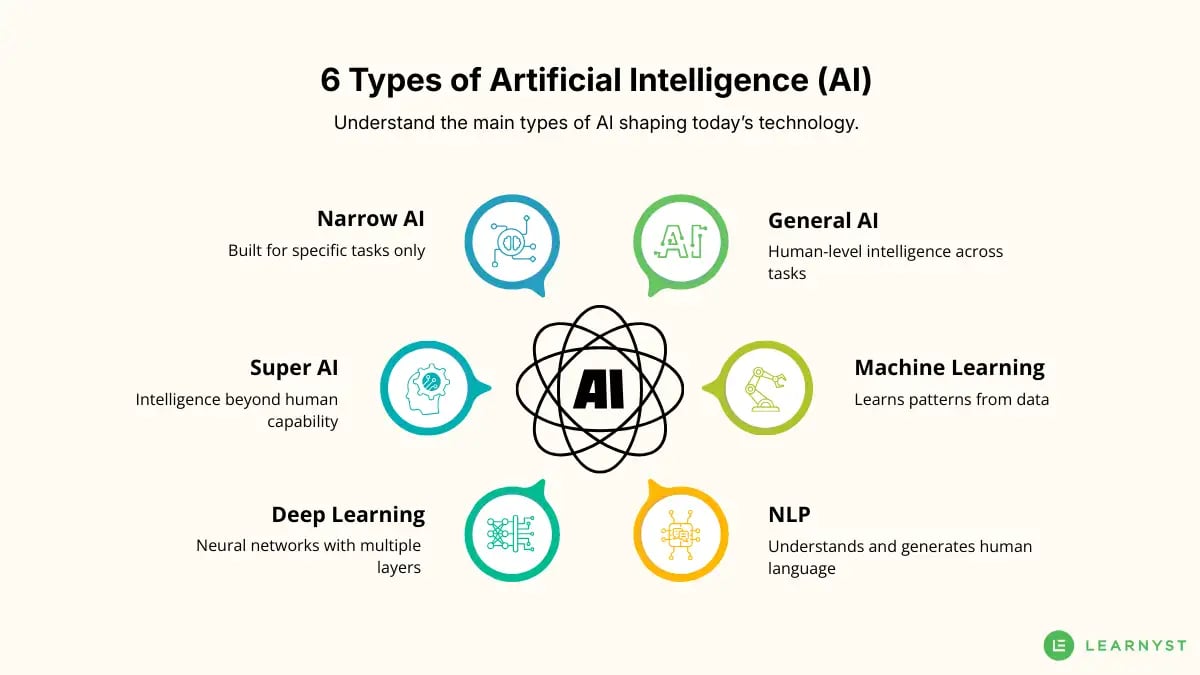
1. Narrow AI (Weak AI): The Most Common Type of Artificial Intelligence
Narrow AI is built to excel at one specific task, and it does so remarkably well.
Here are some examples you probably encounter every day:
- Google Search
- Face recognition on smartphones
- Chatbots
- Recommendation systems
Every AI system we use today falls into the category of Narrow AI.
Source: Stanford AI Index
2. General AI (Strong AI): Human-Level Artificial Intelligence (Theoretical)
General AI is all about creating machines that can grasp, learn, and use intelligence across a variety of tasks, much like we humans do.
However, as of now, General AI is still just a concept and a goal for researchers to strive towards.
Source: Financial Times
3. Super intelligent AI: The Future of Artificial Intelligence
Imagine a super intelligent AI that could outshine human intelligence in every area, creativity, decision-making, and even emotional understanding.
It's a fascinating idea, but one that's mostly found in academic discussions and ethical debates.
Main Types of Artificial Intelligence Based on Technology
1. Machine Learning (ML): The Core of Modern AI
Machine Learning is all about enabling systems to learn from data and get better on their own over time.
Here are some common types of ML:
- Supervised learning
- Unsupervised learning
- Reinforcement learning
You’ll find ML being used in areas like fraud detection, personalized recommendations, and predictive analytics.
Source: Stanford University
2. Deep Learning: Advanced Artificial Intelligence Models
Deep Learning leverages neural networks with several layers to tackle complex data, such as images, speech, and text.
This cutting-edge technology drives:
- Image recognition
- Voice assistants
- Large Language Models (LLMs)
Source: MIT Technology Review
3. Natural Language Processing (NLP): AI That Understands Human Language
NLP enables AI to understand, interpret, and generate human language.
Examples:
- Chatbots
- Language translation
- Voice assistants
Source: IBM
4. Computer Vision: How AI Sees Images and Videos
Computer vision is all about helping machines make sense of visual information.
It's used in:
- Medical imaging
- Facial recognition
- Autonomous vehicles
Uses of Artificial Intelligence in Real Life (With Examples)
1. Artificial Intelligence in Business and Marketing
AI helps businesses:
- Personalize marketing
- Predict customer behavior
- Automate customer support
According to McKinsey, a whopping 65% of organizations were leveraging generative AI in 2024, nearly double the figure from the year before.
2. Artificial Intelligence in Healthcare
AI supports doctors by:
- Detecting diseases from scans
- Assisting in drug discovery
- Predicting patient outcomes
A study in Nature Medicine revealed that AI can match or even surpass the performance of clinicians in medical imaging tasks.
3. Artificial Intelligence in Education
AI enables:
- Personalized learning
- Automated assessments
- Intelligent tutoring systems
4. Artificial Intelligence in Finance and Banking
AI is widely used for:
- Fraud detection
- Credit scoring
- Algorithmic trading
PwC estimates that AI could add up to $15.7 trillion to the global economy by 2030, with the finance sector standing to gain significantly.
Benefits of Artificial Intelligence for Individuals and Businesses
Artificial Intelligence brings a host of benefits for both individuals and businesses alike.
Here are some key advantages:
- Faster decision-making
- Increased productivity
- Cost reduction
- Personalization at scale
- Data-driven insights
According to the World Economic Forum, when used responsibly, AI has the potential to greatly improve productivity and stimulate economic growth.
Limitations and Risks of Artificial Intelligence
Even though AI is incredibly powerful, it does have its drawbacks:
Bias and Fairness
AI can pick up biases from the data it’s trained on.
Lack of Transparency
Deep learning models often function like “black boxes,” making it hard to understand their decision-making.
High Cost and Energy Consumption
Training sophisticated AI models demands a huge amount of computing power.
Future of Artificial Intelligence: Trends and Predictions
When we think about the future of AI, here are some key areas to keep an eye on:
1. Emphasizing responsible and ethical AI practices
2. Enhancing collaboration between humans and AI
3. Establishing effective regulation and governance
4. Creating smarter, more personalized experiences

Final Thoughts: Why Understanding Artificial Intelligence Matters
Artificial Intelligence is changing the way we work, learn, and live our lives. By grasping what AI is, how it operates, and where it’s headed, you can make smarter choices, whether you’re a student, a professional, an educator, or an entrepreneur.
AI isn’t here to take your place. It’s here to enhance your abilities, if you know how to use it wisely.
FAQs
1. What is Artificial Intelligence in simple words?
Artificial Intelligence, or AI, is a type of technology that allows machines to think, learn, and make decisions similarly to how humans do.
2. What are the main types of Artificial Intelligence?
There are three main types: Narrow AI, General AI, and Super intelligent AI.
3. How is Artificial Intelligence used today?
You can find AI in search engines, healthcare, education, finance, marketing, and automation.
4. Is Artificial Intelligence dangerous?
While AI is incredibly powerful, it can be safely managed when developed with a focus on ethics, transparency, and proper regulations.
5. What is the future scope of Artificial Intelligence?
In the future, AI is expected to become more personalized, better regulated, and seamlessly integrated into our everyday lives.
Comments