
.svg)
If you’re looking for Kajabi alternative, you’re likely past the stage of simply hosting a course. Kajabi is positioned as an all-in-one platform, but as your learning business grows, you start evaluating whether you really need a bundled marketing stack or a platform that is built primarily for structured learning, mobile delivery, and scalable academies.
I’ve observed multiple online course platforms across solo creators, coaching institutes, and training companies, and compared Kajabi and its competitors based on what actually impacts growth: learner engagement, monetisation flexibility, mobile learning, pricing at scale, and control over branding.
This blog covers what Kajabi does well, where it becomes limiting, and which platforms work better depending on your business model.
Key Takeaways
- Kajabi is strong for creators who need funnels, email automation, landing pages, and memberships in one place.
- The need for Kajabi alternative usually starts when payment gateway integration, learning delivery, mobile access, branding, or pricing at scale becomes more important than bundled marketing tools.
- Learnyst fits education businesses that need branded apps, structured courses, cohorts, monetization, and secure course delivery.
- Podia and Systeme.io are better suited for creators who want simpler or more affordable platforms to start selling online.
- LearnWorlds, Thinkific, and Teachable work well for course-focused creators, but each has trade-offs in branding, automation, or scalability.
- Kartra is strong for marketing heavy businesses, while Moodle is better for institutions that need open-source learning infrastructure.
- The best platform depends on your business model: creator funnel, digital product store, coaching institute, academy, or institutional LMS.
Best Kajabi Alternative: Quick Comparison Table
If you’re in a hurry and want a quick glimpse before reading the full Kajabi comparison, here’s a simple table to help you understand which platform fits which type of course business.
| Platform | Best For | Why Choose It Over Kajabi? | Main Limitation |
|---|---|---|---|
| Learnyst | Coaching institutes, academies, test-prep educators | Better for branded apps, structured learning, mobile delivery, and scalable course selling | Not built as a full marketing automation suite |
| Podia | Beginner creators | Simpler and more affordable for selling courses and digital products | Limited for serious learning delivery |
| LearnWorlds | Learning focused educators | Stronger course experience with quizzes, certificates, interactive videos, and SCORM support | Can feel complex |
| Systeme.io | Budget creators | Low-cost funnels, emails, and basic course selling | Weak for academy-style learning |
| Kartra | Funnel heavy businesses | Stronger marketing automation and sales workflows | Not education-first |
| Teachable | Solo course creators | Easier course hosting without Kajabi’s heavy marketing stack | Limited branding and automation |
| Thinkific | Course-first creators | Better course structure and student tracking | Needs integrations for marketing |
| Moodle | Institutions and training teams | Open-source, flexible, and strong for formal learning | Requires technical setup |
What Are the Advantages of Kajabi?
Kajabi’s biggest strength is consolidation. It combines course hosting, email marketing, funnels, landing pages, and memberships into a single platform. For creators who want to avoid stitching together multiple tools, this is a major benefit and one reason many Kajabi alternative are compared against it.
The marketing automation is significantly stronger than most traditional LMS platforms. You can build:
- Email sequences
- Sales funnels
- Webinar flows
- Upsells and order bumps
without external tools.
Also Kajabi is particularly effective for:
- High-ticket coaching programs
- Personal brand-driven businesses
- Membership communities
- Webinar-based selling
Its interface is polished, and the website builder allows creators to launch quickly without technical help.
For marketing-first businesses, Kajabi can replace several tools in the tech stack, which is why every Kajabi comparison needs to look beyond just course hosting.
What Are the Disadvantages of Kajabi?
Kajabi starts to feel limiting when your primary focus is structured learning rather than marketing automation.
Pricing is the biggest constraint. Kajabi’s plans are significantly higher than most LMS platforms, which makes it difficult for small businesses, coaching institutes, and test-prep academies to scale profitably, especially in price-sensitive markets.
Product and user limits on lower tiers can also restrict growth. As you add more courses, funnels, or admin users, you are pushed toward higher plans.
From a learning infrastructure perspective, there are gaps:
1. No Native Razorpay Integration
Kajabi does not offer a native Razorpay integration, which can be limiting for Indian course creators. This makes it harder to directly accept popular local payment methods such as UPI, net banking, and domestic cards.
Using Razorpay requires third-party checkout tools or custom workarounds, adding extra cost and complexity to the payment process.
2. Branded Mobile Apps Come at an Extra Cost
Kajabi offers a fully branded mobile app, but it is not included with its Basic or Growth plans. Course creators must pay an additional $199 per month or upgrade to the Pro plan. Without this add-on, learners access courses through the shared Kajabi app rather than an app published under your academy’s brand.
3. Community-based learning
Kajabi has community features, but they are designed for creator memberships rather than structured classroom-style engagement used by coaching institutes.
4. Structured learning workflows
Kajabi is not built for test prep, cohort-based programs, or multi-level learning paths commonly used in academies.
5. SCORM compliance
Kajabi is not SCORM compliant and does not support uploading SCORM or HTML5 course packages, which limits corporate training and institutions that rely on standardised course interoperability and detailed learner-progress tracking.
At that stage, businesses that are education-first rather than marketing-first start looking for alternative.
What I Looked for in Kajabi Alternative?
To make a fair comparison, I focused on:
- Native Razorpay integration and support for Indian payment methods
- Affordable access to fully branded mobile apps
- Structured course delivery (drip, cohorts, levels)
- Built-in monetization without high platform costs
- Community features for classroom-style engagement
- SCORM support for corporate and institutional training
- Pricing that works for scaling academies
These factors matter more than funnel builders when your business is driven by learning outcomes and volume enrollments.
Top 8 Kajabi Alternative in 2026
1. Learnyst
Learnyst is built as a learning infrastructure platform (LMS platform) rather than a marketing suite. It prioritises delivery, engagement, and monetization for education businesses, which makes it one of the best Kajabi alternatives for education-first brands.
From a monetization perspective, Learnyst includes:
- One-time purchases and subscription pricing
- Courses and bundles
- Custom instalment plans
- Coupons and referral programs
- Landing pages and lead generation forms
- Razorpay and other payment gateway integrations
- 0% platform transaction fees
Best for
Learnyst is best for coaching institutes, academies, test-prep educators, and education businesses running structured online programs.
It works especially well when structured and protected content delivery, Indian payment gateways, learner engagement, branded learning channels, SCORM based training, and content monetization matter more than having a heavy marketing automation suite.
Pros
- Branded website and custom domain
- White-labelled community
- Native Razorpay integration
- SCORM and Tin Can support
- DRM-based content protection
- Branded android and iOS apps
- Suitable for structured learning businesses
- Supports courses, bundles, batches, mock tests, test series, and communities
- Better fit for Indian academies because of local payment support
- Useful for test-prep, coaching, and professional education businesses
- Education-first platform instead of a generic creator funnel tool
- Subscription, one-time, and custom instalment pricing options
|
Most Indian students pay by UPI. Kajabi has no Razorpay support. Learnyst comes with Razorpay built in - UPI, netbanking, cards, and wallets, all working from day one. See Learnyst's payment options → |
Cons
- Not built as a full marketing automation replacement for Kajabi
- May not be necessary for creators selling only one simple course
- Businesses looking only for email funnels and webinar selling may still prefer a marketing-first platform
Learnyst Pricing
- Essential: $49/month
- Professional: $149/month
- Premium: $249/month
- Business: $799/month
- Enterprise: Custom pricing
- 7 days free trial is available
Note: Prices may vary based billing terms, app requirements, and currency exchange rates.
Why choose Learnyst over Kajabi?
Choose Learnyst over Kajabi if your business is built around structured learning, mobile-first delivery, branding, and scalable course monetization, Razorpay integration, or SCORM support.
Kajabi is strong when the business is driven by funnels and creator-led marketing. Learnyst becomes stronger when the business needs a proper academy setup with branded apps, course delivery workflows, student engagement, and pricing that works better for volume-based education models.
For coaching institutes, test-prep brands, and education companies, this difference is critical. You are not just building a sales funnel. You are building a learning business.
Why not choose it?
Do not choose Learnyst if your main requirement is advanced email marketing automation, complex webinar funnels, or a creator-style marketing suite.
If you are a solo creator selling high-ticket coaching through funnels and do not care much about branded learning apps, structured delivery, or academy-style engagement, Kajabi may still feel more familiar.
Website - https://www.learnyst.com/
2. Podia
Podia is a lightweight all-in-one platform for creators who want to sell courses, digital products, coaching, and memberships without dealing with too much complexity.
It is closer to Kajabi in the sense that it combines multiple creator tools in one place, but it is simpler and more affordable. It offers course hosting, digital downloads, coaching, email broadcasts, simple sequences, affiliate features, and website chat.
However, it does not go very deep into advanced automation, student analytics, or mobile learning. Among platforms like Kajabi, Podia is more beginner-friendly and less complex.
Best for
Podia is best for beginner creators, solo educators, and small digital product businesses that want a simple platform to start selling online.
It works well when the goal is to launch quickly without paying Kajabi-level pricing.
Pros
- Simple and beginner-friendly
- More affordable than Kajabi
- Supports courses, digital products, coaching, and memberships
- Email broadcasts and basic drip campaigns are available
- Good option for creators who do not want a complicated setup
- Useful for selling multiple digital products from one place
Cons
- No dedicated mobile apps
- Community features are basic
- Marketing automation is limited compared to Kajabi
- Not ideal for advanced learning analytics
- Not built for structured academy-style delivery
Podia Pricing
- Mover: $49/month or $42/month billed yearly
- Shaker: $99/month or $84/month billed yearly
- Earthquaker: $179/month or $150/month billed yearly
- 30 days free trial is available
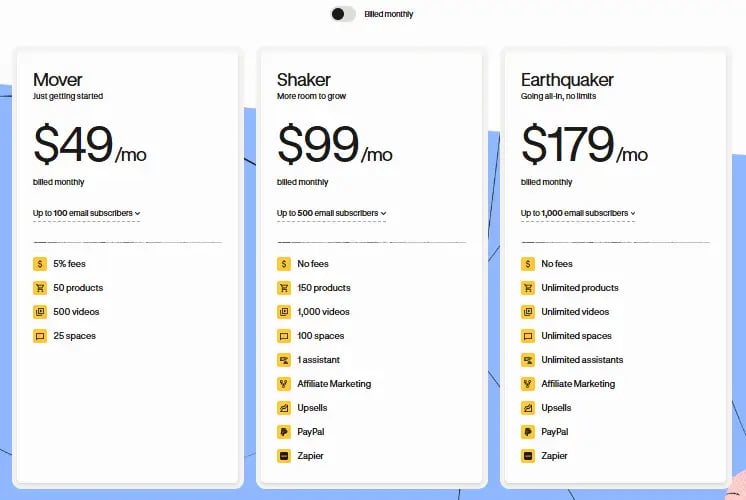
Note - Mover has a 5% transaction fee, while Shaker has 0% transaction fees.
Why choose Podia over Kajabi?
Choose Podia over Kajabi if you want a simpler and more affordable way to sell courses and digital products.
Kajabi can feel expensive if you are still testing your offer or selling basic products. Podia makes more sense when you want the core creator tools without paying for a heavy marketing suite or committing to a higher Kajabi plan.
It is a good option for creators who want to move fast and keep the platform simple.
Why not choose it?
Do not choose Podia if your course business depends on mobile learning, advanced student tracking, deep automation, or structured classroom-style engagement.
For scaling academies, coaching institutes, or test-prep businesses, Podia may start feeling too lightweight as the business grows.
Website - Click here
3. LearnWorlds
LearnWorlds is a feature-rich learning management system platform with stronger academic and course creation features than many creator-first platforms.
It includes features like memberships, quizzes, certificates, course compliance, blogging, community features, SCORM/HTML5 support, surveys, and interactive videos.
Its interactive video feature is one of its strongest learning-focused advantages, but the platform can feel overwhelming because there are many features packed together. This makes it an important name in any serious Kajabi comparison.
Best for
LearnWorlds is best for educators, training businesses, and academic-style course creators who want deeper course creation features.
It is useful when interactive learning, assessments, certificates, and structured course experiences matter more than simple course hosting.
Pros
- Strong course creation features
- Interactive video support
- SCORM/HTML5 support
- Supports quizzes, certificates, memberships, blogging, and communities
- Better suited for academic-style learning experiences
- White-label functionality is available in higher plans
Cons
- Interface can feel cluttered
- Advanced features are often locked behind higher plans
- Marketing automation is not as strong as Kajabi
- Checkout and funnel features are not as deep as marketing-first platforms
- May feel heavy for beginners
LearnWorlds Pricing
- Starter: $29/month or $24/month billed yearly
- Pro Trainer: $99/month or $79/month billed yearly
- Learning Center: $299/month or $249/month billed yearly
- High Volume & Corporate: Custom pricing
- 30 days free trial is available
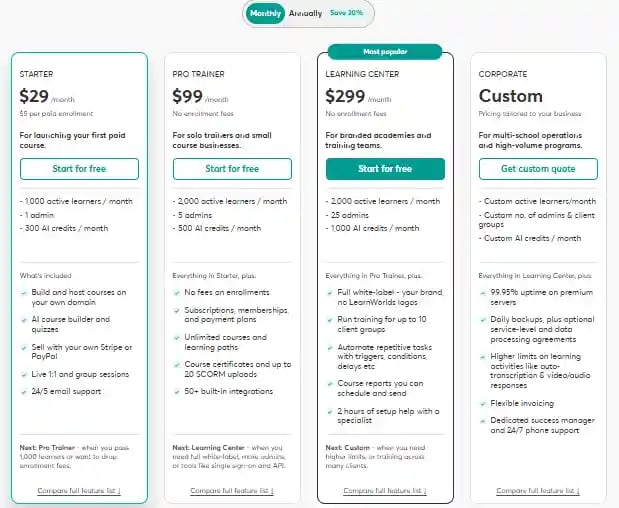
Note: Starter has a $5 fee per course enrollment, while Pro Trainer and above have 0 transaction fees. Prices exclude VAT, and payment gateway fees may still apply.
Why choose LearnWorlds over Kajabi?
Choose LearnWorlds over Kajabi if you want stronger academic learning features and more interactive course experiences. Kajabi is stronger as a marketing and funnel platform. LearnWorlds is stronger when your priority is course depth, learner interaction, assessments, and structured education delivery.
It is a good Kajabi alternative for educators who focus more on learning experience than just the sales funnel.
Why not choose it?
Do not choose LearnWorlds if you want a very simple platform or if your main need is advanced marketing automation.
The platform has many features, but that also makes it feel more complex. If you want quick setup and cleaner creator workflows, it may feel heavier than necessary.
Website - Click here
4. Systeme.io
Systeme.io is an affordable and versatile platform that covers courses, sales funnels, email marketing, membership sites, digital products, and automation.
It's a good Kajabi alternative from a marketing-stack angle because it focuses heavily on funnels and automation. The biggest advantage is pricing. It gives creators a low-cost way to build funnels, sell products, and run email campaigns without investing in multiple tools.
However, its course creation and learning features are not as deep as dedicated LMS platforms. For creators comparing alternative to Kajabi, Systeme.io mainly stands out because of affordability.
Best for
Systeme.io is best for entrepreneurs, coaches, consultants, and beginner creators who want an affordable funnel-first platform.
It works well when the goal is to launch offers, build landing pages, run email campaigns, and sell simple courses or memberships.
Pros
- Very affordable compared to Kajabi
- Strong funnel-building features for the price
- Includes email marketing and automation
- Supports courses, memberships, and digital products
- Good option for beginners testing their first online business
- Free plan makes it easier to start
Cons
- No dedicated mobile app
- Course creation features are not very advanced
- Fewer customization options
- Limited student insights and learning analytics
- Not ideal for academy-style delivery
Systeme.io Pricing
- Free: $0/month (limited features)
- Startup: $17/month or $170 billed annually
- Webinar: $47/month or $470 billed annually
- Unlimited: $97/month or $970 billed annually
- Yearly billing gives 2 months free
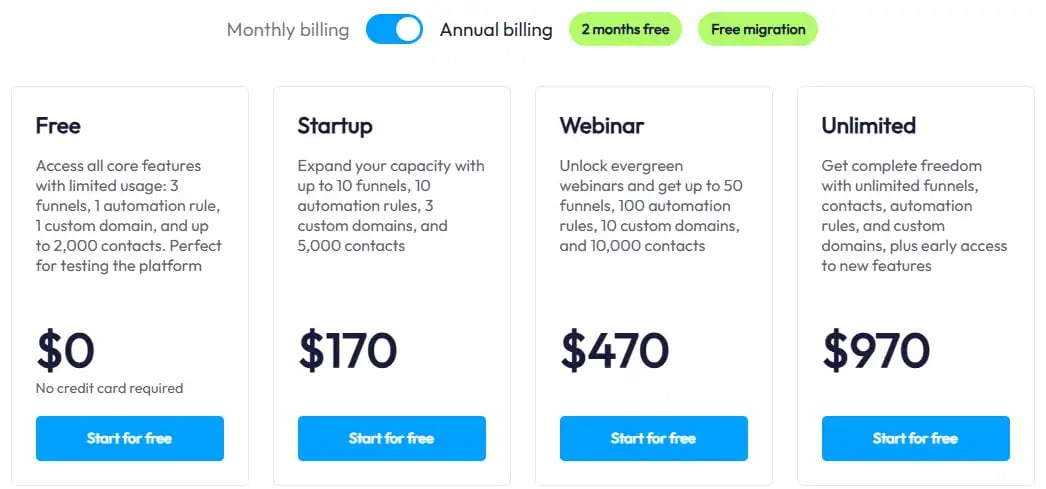
Note: All plans include unlimited emails, unlimited file storage, unlimited students, and 0% transaction fees.
Why choose Systeme.io over Kajabi?
Choose Systeme.io over Kajabi if you want the all-in-one funnel experience at a much lower cost. It is useful when your business is still early and you need landing pages, email campaigns, funnels, and basic course delivery in one place.
For creators who find Kajabi expensive, Systeme.io gives a more budget-friendly way to build a marketing-first setup.
Why not choose it?
Do not choose Systeme.io if your main focus is high-quality learning delivery, branded mobile learning, advanced assessments, or structured student engagement.
It is closer to a funnel platform than a best LMS for a course business. That makes it good for selling, but not always strong enough for education-first businesses.
Website - Click here
5. Kartra
Kartra is a integrated platform built more around online business management and marketing than learning delivery.
It offers email marketing, landing pages, sales funnels, membership sites, video hosting, webinars, and advanced marketing features. Its strength is conversion. Features like behavioral marketing, dynamic offers, and split testing make it useful for businesses that want to build sophisticated sales systems.
But it is more of a funnel and marketing platform than a dedicated LMS. Among Kajabi competitors, Kartra is one of the more marketing-heavy options.
Best for
Kartra is best for marketers, coaches, consultants, and digital businesses that need strong funnels, landing pages, email automation, and sales workflows. It works well when the course is part of a larger marketing machine.
Pros
- Strong marketing automation features
- Good sales funnel capabilities
- Includes landing pages, email marketing, memberships, video hosting, and webinars
- Useful for advanced offer building and segmentation
- Better suited for conversion-focused businesses
Cons
- Can feel overwhelming for beginners
- Pricing may feel high for small creators
- Not built primarily as a learning platform
- Course delivery features are not as education-focused as dedicated LMS platforms
- Better for funnels than structured learning
Kartra Pricing
- Essentials: $59/month or $52/month billed yearly
- Starter: $119/month monthly, or around $99/month billed yearly/promotional
- Growth: $229/month or $189/month billed yearly
- Professional: $549/month or $429/month billed yearly
- 14 days free trial is available
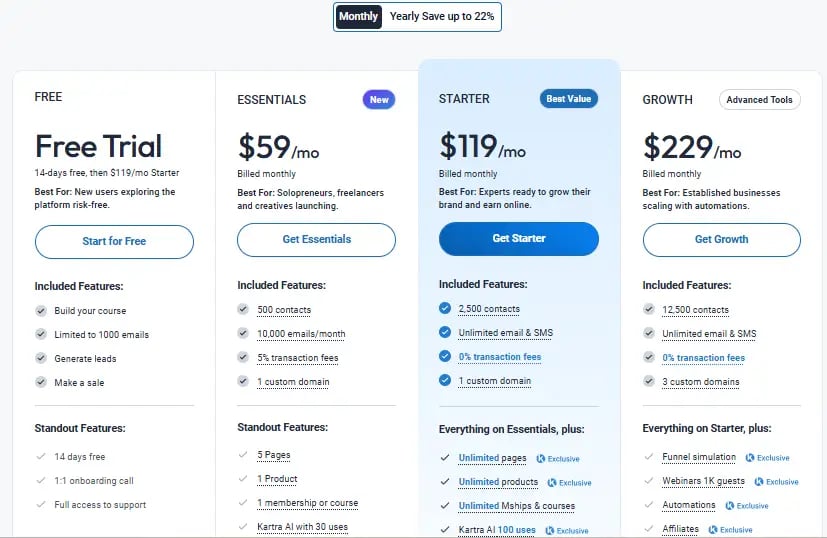
Note: Essentials has 5% transaction fees, while Starter and higher plans have 0% transaction fees.
Why choose Kartra over Kajabi?
Choose Kartra over Kajabi if your biggest requirement is marketing depth. Kartra is useful when you want more control over funnels, offers, automation, and conversion workflows. It is a strong option where the course is one part of a larger digital sales system.
If your priority is selling and optimizing offers, Kartra can be a strong Kajabi alternative.
Why not choose it?
Do not choose Kartra if your primary goal is to build a structured learning business.
It is not the best fit for academies, coaching institutes, test-prep brands, or educators who need strong learner engagement, branded mobile apps, assessments, and classroom-style delivery. For education-first businesses, Kartra may feel powerful but misaligned.
Website - Click here
6. Teachable
Teachable is a simpler LMS website compared to Kajabi. It focuses on course hosting rather than marketing automation.
It is easier to use and more affordable, making it a good choice for creators who are searching for sites like Kajabi.
Best for
Teachable is best for creators who already have their website, email marketing, and lead generation system in place. It works well when you simply need a clean course hosting platform.
Pros
- Easy to use
- Strong course creation features
- Good for standalone video courses
- Supports quizzes, certificates, and compliance features
- Useful for creators who do not need a full marketing suite
- Faster to set up than complex LMS platforms
Cons
- Not a complete all-in-one platform
- Limited marketing automation
- No strong branded mobile app experience
- Product limits and transaction fees can become restrictive on lower plans
- Not ideal for scaling academies
Teachable Pricing
- Starter: $39/month or $29/month billed yearly
- Builder: $89/month or $69/month billed yearly
- Growth: $189/month or $139/month billed yearly
- Custom: Custom pricing
- 7 day free trial is available
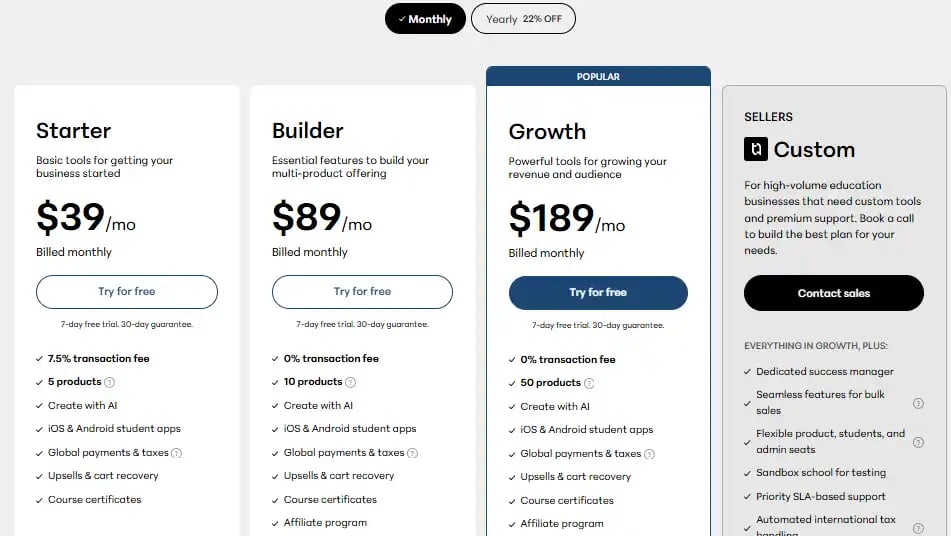
Note: Starter has a 7.5% transaction fee, while Builder and Growth have 0% transaction fees. Teachable also has product and student limits based on the plan.
Why choose Teachable over Kajabi?
Choose Teachable over Kajabi if you want a simpler course platform and do not want to pay for a full marketing stack.
Kajabi gives you funnels, emails, automations, and website tools. Teachable makes more sense when you already have those systems elsewhere and only need course delivery.
It is a practical option for creators who want to keep the tech stack simple.
Why not choose it?
Do not choose Teachable if you want everything inside one platform.
If your business needs advanced funnels, strong community features, branded mobile apps, or structured academy workflows, Teachable may feel limited as you grow.
Website - Click here
7. Thinkific
Thinkific sits between Teachable and Kajabi. It offers stronger learning features than Kajabi while remaining more affordable. It provides better student tracking, more flexible course structuring, and improved community features compared to Teachable.
However, like Kajabi, it does not offer a fully branded mobile app, and its built-in sales workflows are limited compared to funnel-driven platforms.
If you are comparing websites like Kajabi, Thinkific sits closer to a learning-first platform than a funnel-first platform.
Best for
Thinkific is best for creators and educators who want better course structure without needing Kajabi’s full marketing suite.
It fits well when the priority is course delivery, student progress, and structured learning.
Pros
- Strong course creation features
- Supports different course formats
- Useful student-level insights
- Good for drip content, cohorts, and memberships
- No transaction fees on paid plans, according to the referenced comparison
- Better learning structure than basic course platforms
Cons
- Not a full marketing automation platform
- Interface can feel dated
- Community features are basic
- Mobile app experience is not strong enough for branded learning businesses
- Requires integrations for many marketing workflows
Thinkific Pricing
- Basic: $54/month or $40/month billed annually
- Start: $109/month or $82/month billed annually
- Grow: $219/month or $164/month billed annually
- Plus: Custom pricing
- 30 days free trial is available
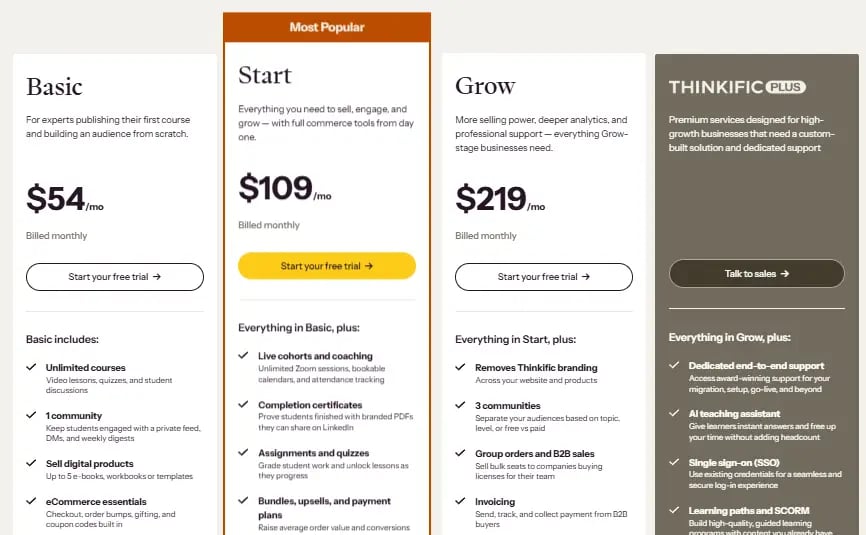
Note: Branded mobile app is available as a $199/month add-on, and included only on select Plus plans.
Why choose Thinkific over Kajabi?
Choose Thinkific over Kajabi if you want structured learning features without paying for Kajabi’s unified marketing stack. It is a better when the course experience matters more than funnels. For creators who already have separate tools for email, landing pages, and marketing, Thinkific can be a more focused option.
In a Kajabi vs Thinkific comparison, Thinkific makes more sense when learning structure matters more than marketing automation.
Why not choose it?
Do not choose Thinkific if you want a complete business engine in one platform. If you need advanced funnels, branded mobile apps, strong communities, or deeper monetization workflows, Thinkific may require too many external tools.
Website - Click here
8. Moodle
Moodle is a powerful open-source LMS that supports SCORM and complex learning paths. It's widely used by universities and corporate training teams. But it is not designed for selling courses online. There are no built-in sales tools, and it requires technical setup and maintenance.
Moodle can be better than Kajabi only when the requirement is institutional learning infrastructure, not course selling.
Best for
Moodle is best for universities, institutions, internal training teams, and organizations that need open-source learning infrastructure.
It works well when the priority is compliance, learning paths, SCORM, and academic control.
Pros
- Open-source LMS
- Strong for institutional learning
- Supports SCORM and complex learning workflows
- Highly customizable with technical support
- Suitable for compliance-driven training
- Good fit for universities and corporate learning teams
Cons
- Requires technical setup and maintenance
- Not built for selling courses online
- No strong built-in sales and marketing tools
- Can feel complex for creators
- Not ideal for fast launch or monetization
Moodle Pricing
Moodle LMS is free to download and use because it is open-source.
Why choose Moodle over Kajabi?
Choose Moodle over Kajabi if you need open-source flexibility, SCORM support, and institutional learning workflows.
Kajabi is built for creators and marketing-led businesses. Moodle is built for structured learning environments where compliance, customization, and technical control are more important than sales funnels. It is better for institutions than individual course creators.
Why not choose it?
Do not choose Moodle if your goal is to quickly create, market, and sell online courses.
It needs technical resources, setup, maintenance, and external tools for payments, landing pages, emails, and sales. For creator monetization, Moodle can become too heavy and operationally complex.
Website - Click here
Pricing Reality for Small Businesses
Kajabi’s biggest strength, being compact, is also its biggest cost factor. You pay for marketing tools whether you use them or not.
For many education businesses, the real requirement is:
- Branded delivery
- Mobile learning
- Scalable pricing
- Built-in monetization
Platforms that focus on learning infrastructure often become more cost-effective because they reduce both subscription costs and tool complexity.
|
You wanted a course platform. Kajabi sold you a marketing suite. Funnels, email, webinars, landing pages - bundled in, billed monthly, mostly unused. Learnyst starts at $49/month. Courses, tests, apps. Nothing you won't use. See Learnyst pricing → |
Conclusion
Kajabi is powerful for marketing-driven creator businesses, but it is not optimized for structured learning at scale. As soon as your focus shifts to payment gateways, branded academies, mobile-first delivery, cohort programs, or high-volume enrollments, you start looking for something better than Kajabi.
The right platform depends on whether you are building a marketing funnel or a learning business.
For most coaching institutes and education companies, that means choosing a platform that prioritizes learning delivery, branding, mobile engagement, and scalable pricing over bundled marketing automation.
That is the difference between running a creator business and building an academy.
If you are looking for a Kajabi alternative built for your scaling course business, Learnyst is worth exploring. Book a demo and see how you can build, sell, and scale your online academy without outgrowing your platform.
Courses
Tests
Your app
100% yours
Sell courses. Run tests. Own your app. Keep 100% of it.
Learnyst gives you DRM protection, white-label Android + iOS, and 0% transaction fees.
Book a free demo →FAQs
What are the best Kajabi alternative?
Some of the best Kajabi alternatives are Learnyst, Podia, LearnWorlds, Systeme.io, Kartra, Teachable, Thinkific, and Moodle. The right choice depends on your business requirement.
What is the cheapest Kajabi alternative?
Systeme.io is one of the most affordable alternatives to Kajabi because it has a free plan and even paid plans are also low.
Is there a free Kajabi alternative?
Yes. Systeme.io offers a free plan, though the features are very limited in a free plan which are not sufficient for an online course business.
Why is Kajabi so expensive?
Kajabi is expensive because it bundles course hosting, website building, email marketing, funnels, memberships, and automation altogether. If you don’t use all these tools, it’s definitely not worth it.
Does Kajabi support Razorpay?
No. Kajabi does not offer a native Razorpay integration. Indian businesses must use a third-party checkout tool or custom integration to accept payments through Razorpay.
Is Kajabi SCORM compliant?
No. Kajabi does not support SCORM or HTML5 course packages, making it less suitable for organisations that rely on standardised e-learning content.
Read More:
Why Learnyst Is the Best Graphy Alternative for Test-Prep Businesses & Coaching Institutes in 2026
Comments