


Imagine it’s Sunday night. You log into your LMS dashboard, and it’s the same old story: a good number of learners haven’t checked in, quiz scores are all over the place, discussion posts are sparse, and the course completion graph resembles a slow leak.
What you really need isn’t “more content,” but smarter learning decisions on a larger scale. That’s where an AI powered LMS comes into play. It’s designed to help you tailor learning paths, spot at risk students early, automate those tedious tasks, and boost outcomes all without turning your course into a soulless robot factory.
Here’s a straightforward guide that lays everything out clearly: it explains what an AI LMS is, what it does, how it operates, and how to implement it responsibly.
What is AI Powered LMS?
A traditional Learning Management System (LMS) does a solid job of delivering content and keeping track of the basics like logins, completion rates, and grades.
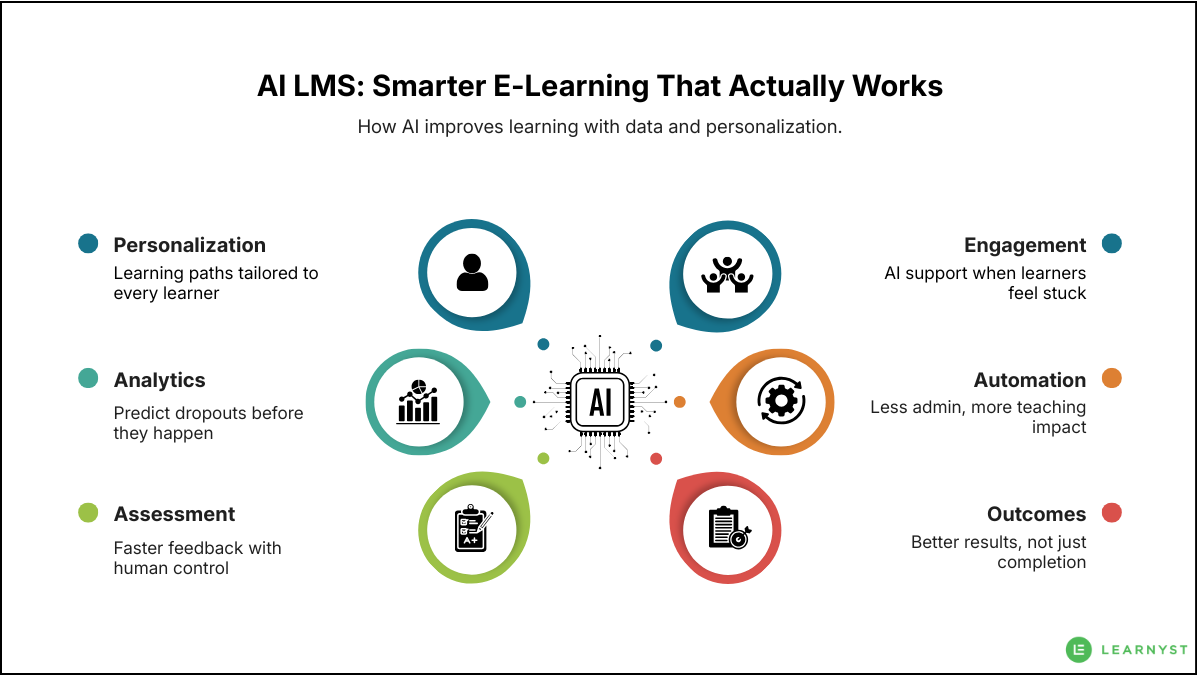
But an AI powered LMS takes things to the next level. It leverages advanced models think machine learning, natural language processing, and even generative AI to:
- Identify the risk of learners dropping out, failing, or becoming disengaged.
- Tailor the difficulty and order of content to fit individual needs.
- Provide real time tutoring and feedback support.
- Streamline instructor tasks like grading, creating rubrics, and suggesting feedback.
- Enhance course design using learning analytics and recognizing patterns.
In simple words, your LMS transforms from just a place to store information into a powerful decision making tool.
Why AI improves e learning outcomes (and not just efficiency)
1. You can see real learning improvements with tutoring style AI.
When it comes to AI in education, one of the most compelling pieces of evidence comes from Intelligent Tutoring Systems (ITS). Studies have shown that ITS can actually outperform traditional teaching methods, delivering moderate to significant learning gains (for instance, effect sizes around d ≈ 0.71 in a meta analysis focused on college students).
This is important because “tutoring effects” can be tough to scale. AI steps in to provide that personalized support without the need for a one on one human tutor for every student.
2. You can enhance tutor effectiveness in actual classrooms.
A randomized controlled trial led by Stanford on a human AI tutoring assistant revealed some impressive results:
- Students were 4 percentage points more likely to succeed in their session assessments when their tutors utilized the AI assistant.
- For tutors who were rated lower or had less experience, students’ math skills improved by an average of up to 9 percentage points compared to similar tutors who didn’t have AI support.
This serves as a practical guide for integrating AI into a Learning Management System (LMS): enhance the instructor’s role rather than replace them.
3. You can detect risk earlier using LMS behavior signals
If you’ve ever thought, “I wish I knew someone was slipping before the final week,” AI helps.
A 2024 peer reviewed study using transcript, demographic, and LMS (Moodle) activity data found LMS activity to be among the most important predictors of degree program dropout, and reported model performance that improved over time (e.g., precision increasing from 66% to 74% in their longitudinal setup).
In an AI LMS, that turns into early alerts, targeted nudges, and proactive support before disengagement becomes failure.
4. Generative AI can improve learning outcomes if you use it as an intervention, not a shortcut
A systematic review and meta analysis from 2024 found that using ChatGPT in educational settings can really enhance academic performance. It not only boosts motivation and engagement but also encourages deeper thinking while making tasks feel less mentally taxing though it doesn’t seem to have a big impact on self confidence.
The magic word here is "interventions." It’s all about creating workflows where AI supports learners in thinking more critically, rather than just speeding through their work.
The most valuable AI Powered LMS use cases (what you should implement first)
1. Personalized learning paths (adaptive sequencing)
In a traditional LMS, everyone follows the same route. But with an AI powered LMS, the journey adapts to each learner:
- Those who excel in diagnostics can skip the basics.
- Learners who find certain topics challenging receive extra help and practice.
- The system not only adjusts the pace but also the sequence of learning.
This approach is particularly effective for skill based subjects like math, languages, test preparation, coding, and compliance training.
What this looks like in practice
You set up:
- A short diagnostic quiz
- Mastery thresholds (e.g., 80%+)
- Remediation content for areas where learners struggle.
- Automatically assigned practice sets.
AI determines the next content a learner needs based on their performance patterns instead of sticking to a rigid outline.
2. AI tutoring within lessons (micro help at the moment of confusion)
You’ve probably noticed this: learners don’t fail due to laziness they often get stuck and can’t find their way back.
An AI tutor embedded in your LMS can:
- Simplify explanations of concepts.
- Provide hints step by step (rather than just giving final answers).
- Create additional examples.
- Pose Socratic follow up questions
When done right, it acts like a 24/7 teaching assistant, reducing frustration and boosting engagement especially in self paced courses.
Best practice
Adopt a “hint first” tutoring approach. The focus should be on learning, not just speeding through tasks.
3. Early warning signals and intervention workflows
This is where AI truly shines in operational effectiveness.
Here are some signals an AI LMS can monitor:
- A drop in logins or time spent on tasks.
- Missing assignments.
- Low quiz scores on prerequisite modules.
- Decreased participation in discussions.
- Erratic learning patterns (like bingeing on content and then disappearing).
Your LMS can then trigger:
- Personalized reminders.
- Suggested catch up plans.
- Options for booking office hours.
- Notifications for instructors when a learner hits a risk threshold.
This method is backed by research indicating that LMS activity is a strong predictor of outcomes and dropout risks.
4. Smarter assessments and quicker feedback (with a human touch)
The speed of feedback is crucial. Learners thrive when they can quickly see where they stand and make adjustments.
AI can help with:
- Crafting feedback that aligns with rubrics
- Recommending next steps and resources
- Identifying misconceptions
- Generating different question variations for practice
A write up from the University of Georgia on a research study points out that large language models can grade written responses swiftly, but they also come with accuracy concerns, like relying on “keyword shortcuts.” This is precisely why incorporating a human element in the process is essential.
Practical workflow
- AI drafts the feedback
- The instructor reviews and approves it (especially for important grading)
- AI delivers immediate feedback for practice assignments (which carries less risk)
5. Enhancing course design through learning analytics
Once AI is integrated into your system, your Learning Management System (LMS) turns into a feedback loop for your course:
- Which lessons lead to drop offs?
- Which quiz questions don’t effectively differentiate?
- Where do high achievers hit a snag (possibly due to unclear content)?
- Which resources are linked to student success?
AI helps you uncover patterns that might go unnoticed, especially when dealing with large groups of students.
How you implement an AI Powered LMS without chaos
Step 1: Focus on one clear problem
Choose a key performance indicator (KPI):
- Course completion rate
- Time to mastery
- Assessment pass rate
- Dropout reduction
- Instructor time saved (while keeping quality intact)
Next, align it with a specific AI feature:
- For completion issues → use early warnings and nudges
- For mastery issues → implement adaptive practice and tutoring
- For instructor overload → leverage feedback drafting and automation
Step 2: Adopt a “human in the loop” approach as your default
Establish a solid foundation:
- For formative work: AI can provide instant feedback
- For summative work: AI assists, but humans make the final call
This strategy fits well with the known limitations of automated grading and the concerns educators have when adopting new technologies.
Step 3: Test it out with a pilot and A/B design
Don’t just go by gut feelings. Conduct a brief pilot:
- Two groups
- Same instructor and content
- One group with AI features enabled, the other without
Then, compare the results and satisfaction levels.
Step 4: Set boundaries for academic integrity
If students can just copy answers into an AI tutor and submit them, you’ll end up with a “completion machine” instead of real learning.
Here are some practical boundaries:
- Use a Socratic tutoring mode (offering hints and questions)
- Require students to reflect (“Explain why this answer is correct”)
- Conduct oral checks or live quizzes for key outcomes
- Incorporate more project based assessments
Risks you should address directly (so trust goes up, not down)
1. Bias and fairness
Prediction models can sometimes mirror past inequalities. Here are some ways to address this:
- Steer clear of using protected attributes unless you have a solid, well reviewed reason to do so.
- Keep an eye on false positives and negatives across different subgroups.
- Implement supportive interventions rather than punitive ones.
2. Privacy and data minimization
If you don’t need certain data, it’s best not to collect it.
- Limit event data to its intended purpose.
- Use de identification whenever you can.
- Establish clear timelines for data retention.
3. Over reliance
When learners lean too heavily on AI, it can hinder their thinking and learning. Your design should encourage productive effort:
- Provide scaffolding for problem solving.
- Ask for explanations.
- Reward the process, not just the final answers.
Final Thoughts: Where AI Powered LMS Really Makes the Difference
When you take a step back and consider the bigger picture, an AI LMS isn’t just about replacing teachers or turning learning into something cold and mechanical. It’s really about empowering you to make better decisions sooner, quicker, and with greater confidence.
You probably already realize that learners don’t always struggle in obvious ways. They might drift off, hesitate, or quietly get stuck. AI can help highlight those moments while they still matter, allowing you to step in with the right support instead of waiting until the outcomes are already set in stone.
The true value of AI shines through when it operates behind the scenes: customizing learning paths without complicating things, providing guidance without simply handing out answers, and taking care of repetitive tasks so you can concentrate on teaching, mentoring, and enhancing the course itself. Research consistently shows that when AI is utilized as a support system not a shortcut it can boost learning outcomes, engagement, and efficiency all at once.
If you approach AI with clear objectives, solid boundaries, and a mindset that keeps humans in the loop, your LMS transforms from just a content delivery tool into a genuine learning partner. In a world where learners crave relevance, speed, and personalization, that transformation is no longer optional it’s what distinguishes average e learning from truly effective learning experiences.
FAQs
1. What Is an LMS AI?
An LMS AI, or Artificial Intelligence Learning Management System, is a platform designed to enhance the teaching and learning experience through the power of artificial intelligence. It streamlines repetitive tasks and tailors learning experiences to better suit both educators and students.
Rather than juggling everything manually, AI can lend a hand with creating content, assessing progress, making recommendations, and boosting student engagement.
2. Does AI actually improve learning outcomes?
Research, including peer reviewed meta analyses and experimental studies, indicates that AI can have a positive impact in various settings, like intelligent tutoring systems and structured generative AI interventions. However, the results largely depend on how well the instructional design is set up and the safeguards in place.
3. Is AI grading safe?
While AI can accelerate the feedback process, its accuracy and validity can differ. The best practice is to keep a human involved in the loop, especially when it comes to high stakes grading.
4. Is an LMS With AI Worth It?
Absolutely! An LMS that incorporates AI can really boost efficiency, enhance learner engagement, and streamline content delivery. As AI technology keeps advancing, more and more educators and organizations are turning to AI-driven learning platforms to craft smarter and more tailored learning experiences.
Comments